IT Strategy · 8 min read
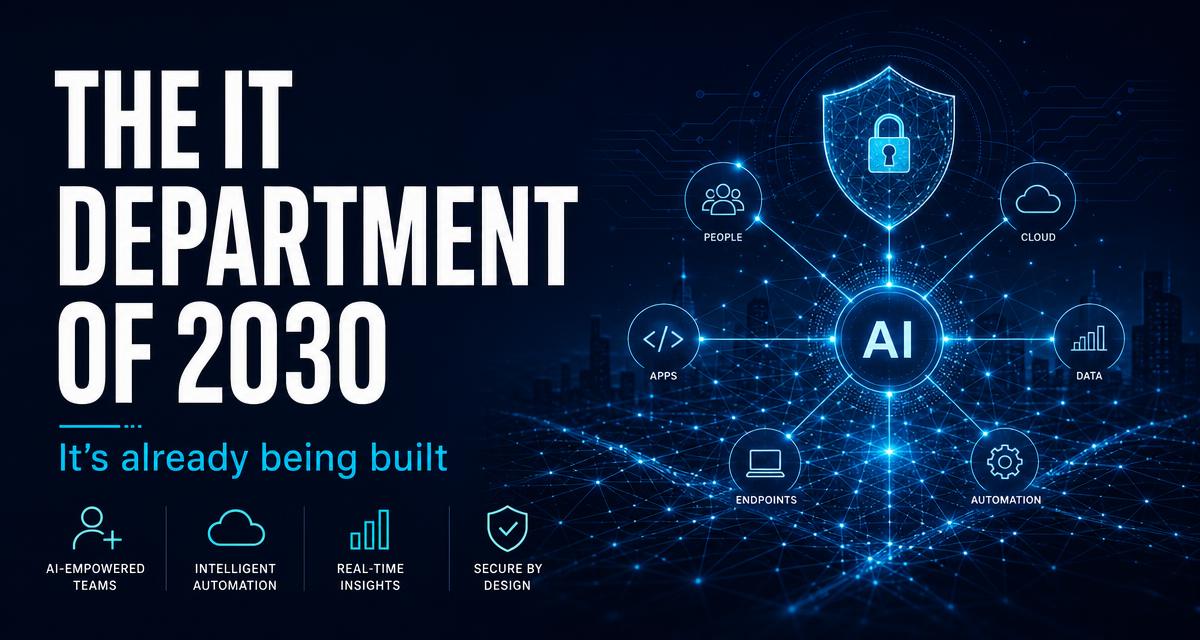
The IT Department of 2030 Isn't Coming — It's Already Being Built
The future doesn't arrive all at once. It arrives one decision at a time — and the decisions shaping the IT department of 2030 are being made in ordinary budget meetings right now.
Introduction: the future already feels ordinary
Walk into almost any modern workplace today and you'll notice something remarkable. Employees join meetings from different continents without thinking twice. Documents are created, edited and shared in seconds. Artificial intelligence drafts emails, summarizes meetings and helps troubleshoot technical issues before an IT engineer has even opened a support ticket.
Five years ago, much of this would have sounded futuristic. Today it's becoming ordinary.
Yet despite this progress, many organizations still plan their IT strategy as though it's 2018. They buy hardware instead of modernizing processes. They hire more people to manage outdated workflows instead of investing in automation. They react to cyber threats instead of designing environments that anticipate them. Most importantly, many still see IT as a department that fixes problems rather than one that drives business growth.
That mindset won't survive the next decade.
Having worked with organizations of different sizes, I've learned that technology itself is rarely the biggest challenge. Most businesses can buy the same software, subscribe to the same cloud services and deploy similar security tools. What separates successful organizations isn't the technology they own — it's how they choose to use it.
The core idea
"The IT department of 2030 isn't defined by faster computers or smarter software. It's defined by a different way of thinking — and in many organizations, that future has already begun."
Five shifts defining the future of IT
Strip away the vendor noise and the transformation comes down to five shifts. Each one is already visible in organizations that treat digital transformation as a leadership discipline rather than a purchase order.
IT is no longer a support function
The question moved from “Why isn't my email working?” to “How can technology help us grow?” Technology has moved from the basement to the boardroom.
AI becomes every employee's colleague
AI's greatest value isn't cutting headcount — it's giving time back. Time to think, solve, innovate, mentor and work with customers.
Cybersecurity becomes invisible
Adaptive authentication, behaviour-based alerting and self-isolating devices. Zero Trust stops being a project and becomes the default posture.
The workplace is built around experience
Employees compare work tech with Netflix and Google — not with competitors. Single sign-on, intelligent search, automated workflows: technology that disappears.
Leadership becomes the top technical skill
Every transformation succeeds or fails on people. Someone has to explain why change matters and create excitement instead of uncertainty.
IT is no longer a support function
For decades, IT departments were measured by how quickly they could fix problems. The printer stopped working. A password needed resetting. Someone couldn't access a shared folder. Success meant restoring normal operations as fast as possible.
Those responsibilities will always exist, but they no longer define modern IT. Today's technology teams are becoming strategic business partners. They're expected to improve productivity, reduce operational costs, strengthen cybersecurity, simplify collaboration and enable innovation across the entire organization. That's the same trajectory I described in scaling proactive IT support.
AI in business: every employee's colleague
One of the biggest misconceptions about artificial intelligence is that it's designed to replace people. I don't believe that's where the greatest value lies. The businesses seeing the strongest results aren't reducing their workforce because of AI — they're giving their people better tools.
Imagine an IT technician who spends two hours a day searching documentation. A project manager who manually summarizes every meeting. A finance team processing hundreds of repetitive emails a week. None of them were hired to spend the day on administrative work.
AI gives them something more valuable than automation. It gives them time:
- Time to think and solve real problems.
- Time to innovate instead of copy-paste.
- Time to work with customers and mentor colleagues.
Technology has always been at its best when it removes barriers instead of replacing people — see practical Microsoft Copilot use cases for what that looks like in a normal Microsoft 365 workday.
Cybersecurity will become invisible
Ask any IT professional about cybersecurity today and you'll hear the same thing: the threat landscape changes constantly. New vulnerabilities appear daily. Phishing has become convincing. Attackers already use automation — soon they'll use AI far more effectively.
The future of cybersecurity isn't buying another security product. It's creating an environment where security is part of every process instead of something employees only think about after something goes wrong. By 2030, many security decisions will happen automatically: suspicious logins trigger adaptive authentication, unusual behaviour generates intelligent alerts, compromised devices isolate themselves before they threaten the network.
But technology only detects the problem. Leadership decides how the organization responds. Zero Trust and modern identity with Entra ID are where that starts.
The modern workplace will be built around experience
Employees no longer compare your workplace with other companies. They compare it with the technology they use at home. If Netflix recommends instantly, Google answers in seconds and phones update themselves, why should employees fight outdated business systems?
The future modern workplace prioritizes experience: simple access, single sign-on, secure collaboration, intelligent search, automated workflows. Technology should disappear into the background. When employees stop thinking about technology, they start thinking about their work.
Leadership will become the most valuable technical skill
This may surprise some readers: I believe leadership will become more important than technical expertise. Not because technology matters less — quite the opposite. Technology is becoming so advanced that the biggest challenge isn't implementing it, it's helping people embrace it.
Employees need confidence. Managers need clarity. Executives need trust. Someone has to explain why change matters and create excitement instead of uncertainty. That's leadership. Organizations that invest only in software will struggle; organizations that invest in people alongside technology will thrive. I unpacked this further in AI won't replace great IT leaders.
The IT professional of 2030
Tomorrow's technology specialists won't simply install software or configure servers. They'll advise business leaders, translate technical complexity into business value, protect digital identities, automate repetitive work, analyze data, improve employee experience and lead transformation projects.
Technical knowledge stays essential. But communication, empathy, adaptability and strategic thinking become equally valuable. The best IT professionals won't be remembered because they knew the most commands — they'll be remembered because they helped people succeed. More on that in the modern IT support engineer.
Five things every business should do today
The future isn't something to prepare for someday. It's something to build today. Five practical IT strategy steps:
01Stop treating AI as an experiment
Identify the everyday tasks where AI genuinely improves productivity, then measure the hours returned.
02Invest in modern identity and security
Strong authentication, device management and Zero Trust principles are business priorities — not optional IT projects.
03Automate repetitive work
If employees repeat the same manual task daily, ask whether technology should be doing it instead.
04Invest in continuous learning
Organizations that encourage curiosity adapt faster than those that resist change.
05Make IT part of business strategy
Invite technology leaders into strategic conversations early. The best solutions are designed with business goals in mind — not added afterwards.
The human advantage
For all the excitement around artificial intelligence, cloud computing and automation, one truth remains unchanged: business is built on relationships. Customers trust people. Employees follow leaders. Teams succeed through collaboration.
Technology can accelerate progress, but it can't replace integrity, empathy or sound judgment. Those qualities will define successful organizations in 2030 — and beyond.
Final thoughts
When people imagine the future of IT, they picture robots and fully automated workplaces. I imagine something different: IT departments that spend less time fixing problems and more time creating opportunities. Technology so intuitive that employees barely notice it. Security that is proactive instead of reactive. AI that helps people think bigger instead of work longer. Organizations where technology serves people — not the other way around.
The IT department of 2030 isn't coming. It's already being built. Every investment you make, every process you improve, every employee you empower, every decision to embrace change — those choices are shaping your future today.
The question isn't whether your organization will experience this transformation. The question is whether you'll lead it — or spend the next decade trying to catch up.
Frequently asked questions
What will the IT department of 2030 look like?
Less break-fix, more business strategy. The IT department of 2030 is measured on productivity, security posture, employee experience and enabled innovation — not on how fast it resets passwords.
Will AI replace IT jobs by 2030?
No. AI removes repetitive administrative work and gives time back to people. The greatest value of AI in business is freeing specialists to think, solve, mentor and work with customers.
How will cybersecurity change by 2030?
Security becomes invisible and automatic: adaptive authentication on suspicious logins, behaviour-based alerting, self-isolating compromised devices and Zero Trust principles built into every process instead of bolted on afterwards.
What should businesses do today to prepare for the future of IT?
Stop treating AI as an experiment, invest in modern identity and Zero Trust security, automate repetitive work, fund continuous learning, and bring IT leaders into business strategy conversations early.
Why is leadership the most valuable technical skill?
Technology is now easy to buy and hard to adopt. Every digital transformation succeeds or fails on people — confidence, clarity and trust. Leadership is what turns a licence purchase into real change.
About the author
Davor — I help organizations modernize their IT environments through Microsoft technologies, cloud solutions, cybersecurity, automation and practical digital transformation. The best technology isn't the most complex — it's the technology that quietly helps people do their best work every day.
See about Davor, my skills, my experience or get in touch. More field notes on the blog.
Want to start building that IT department now?
I work with businesses in Copenhagen, across Denmark and the Øresund region on Microsoft 365, Intune, Entra ID and day-to-day IT support.