Leadership · 7 min read
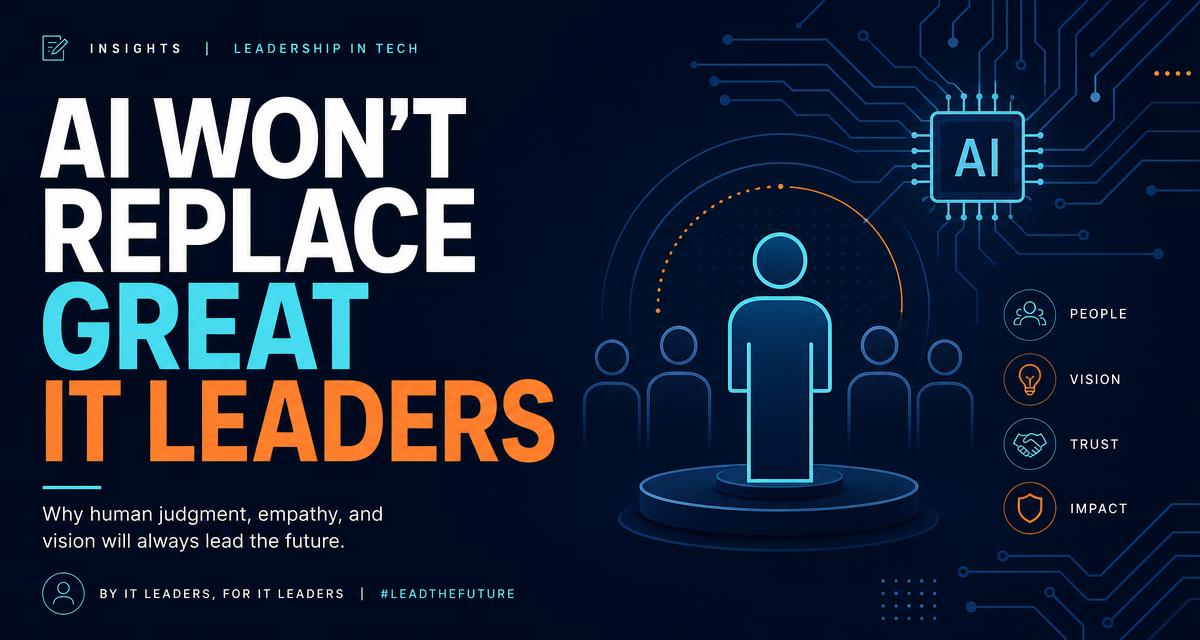
AI Won't Replace Great IT Leaders — Great IT Leaders Will Use AI to Build Better Teams
For years, every major technological breakthrough has triggered the same anxiety: "Will this replace my job?" We asked it when PCs entered the office, and again when cloud computing decentralized the data center. Now, as AI integrates into the daily workflow, that familiar tension has returned.
After 15+ years in the trenches of Microsoft 365 and enterprise IT, I've realized we are asking the wrong question. Technology has never been about replacing people; it's about helping them achieve more. The real question isn't whether AI will replace your team — it's whether you can use it to unlock their full potential.
AI Reveals the Quality of Your Leadership
Many organizations view AI strictly as a cost-cutting measure. The logic is simple but flawed: if AI can handle support tickets, write documentation, and summarize meetings, perhaps headcount can be reduced. That might look good on a quarterly spreadsheet, but it rarely produces long-term success.
In my experience, AI doesn't replace leadership — it reveals it. The organizations seeing the best results aren't buying the most expensive tools or chasing every shiny trend. They are led by people who understand that technology is valuable only when it helps people work smarter, collaborate better, and focus on meaningful tasks.
Instead of asking, "Which employees can AI replace?" great leaders ask, "Which repetitive tasks can AI eliminate so our people can create more value?" That shift changes the entire culture. People become more productive, teams become more engaged, and innovation accelerates because human experts are finally free to do what they do best.
From the trenches
"Throughout my career in IT support, Microsoft 365, cloud services, and digital transformation, I've learned one lesson that continues to prove itself: technology is rarely the biggest challenge. People, communication, and leadership are. The best projects succeed because teams work together — and the best organizations don't chase every new trend. They adopt technology with purpose."
Giving Time Back: The Real ROI of AI
Think about the "friction" that burns your team's week. They spend hours hunting for documentation, drafting meeting notes, resetting passwords, and triaging emails. This is repetitive work that prevents experts from performing high-value tasks.
AI should be measured by the meaningful work it enables, not just the tasks it performs. When you use AI to eliminate friction, you give hours back to every employee. What could they do with that time?
- Strategic thinking and proactive problem-solving.
- Coaching and mentorship for junior staff.
- Deeper customer engagement and collaboration.
A modern IT leader is responsible for creating an environment where technology empowers people rather than overwhelming them. This requires leadership questions, not technology questions: Where are employees losing time? Which manual processes create the most frustration? How can AI improve the experience without removing the human touch?
The Five Pillars of an AI-Augmented Team
Great IT leaders focus on five specific areas when integrating AI:
Eliminating Friction
Simplify knowledge sharing and automate repetitive requests. Less frustration means happier employees — and a better customer experience.
Improving Decisions
AI surfaces trends and anomalies inside massive datasets, so leaders can act proactively instead of reactively.
Strengthening Security
Threats move at machine speed. AI provides fast detection at scale; people provide the judgment. Together they beat either alone.
Investing in People
As tech advances, human skills — communication, empathy, critical thinking — become more valuable, not less.
Building a Culture of Innovation
Innovation happens when people feel safe to experiment. AI supports that curiosity; it isn't the end goal.
The Future Belongs to the Adaptable
The next five years will transform how we work. AI assistants will become standard, documentation will become smarter, and routine administrative work will continue to shrink. None of this eliminates the need for talented people; it simply raises the bar for what we expect from leaders.
We need leaders who can explain change instead of creating fear — leaders who understand that digital transformation is ultimately about people, not software. AI can analyze information and generate code in seconds, but it cannot replace empathy, trust, or the ability to inspire a team during times of uncertainty.
The organizations that thrive won't be those with the largest AI budgets. They will be the ones that use technology to remove barriers, allowing their people to grow and innovate every day. For a related take, see how AI is transforming IT support or how AI drives real business growth.
About the Author
Davor — 15+ years in Microsoft 365, Entra ID, Intune and enterprise IT. Writes about what actually breaks in production, not what the docs say should work. See about Davor, my experience, or get in touch. More field notes on the blog.